What is Aluminum Fabrication?
 Aluminum fabrication is the process of cutting, forming, welding, and finishing aluminum materials to create custom parts and assemblies. Unlike working with steel or other metals, aluminum fabrication requires specialized techniques and equipment designed specifically for this lightweight, versatile material.
The process begins with raw aluminum in various forms—sheets, plates, tubes, or extrusions. Through a combination of cutting, bending, welding, and finishing processes, fabricators transform these raw materials into functional components tailored to your exact specifications.
Why Choose Aluminum?
| Benefit | What It Means for Your Project |
|---|---|
| Lightweight Strength | Weighs 1/3 as much as steel with impressive strength-to-weight ratios. Perfect for transportation, handheld tools, and weight-sensitive applications. |
| Corrosion Resistance | Forms a natural protective oxide layer that prevents rust. Ideal for outdoor, marine, and food processing environments. |
| Easy Fabrication | Can be cut, formed, welded, and finished with standard equipment. Accommodates complex designs and tight tolerances. |
| Cost-Effective | Lower total project cost when factoring in easier fabrication, no rust treatment, reduced shipping, and longer service life. |
| Conductivity | Excellent thermal and electrical properties for heat exchangers, electrical enclosures, and cooling solutions. |
Common Applications
Aluminum fabrication serves these industries:
- Agricultural equipment frames and enclosures
- Architectural railings, trim, and structural elements
- Custom electronics and control system enclosures
- Transportation components (truck beds, trailers, automotive parts)
- Industrial equipment housings and brackets
- Food processing equipment and storage
- HVAC ductwork and ventilation systems
- Custom furniture and display fixtures
Aluminum Fabrication Processes: From Raw Material to Finished Product
Modern aluminum fabrication combines traditional metalworking techniques with advanced technology. Here’s a quick reference for choosing the right process:
| Process | Best For | Typical Lead Time | Precision Level |
|---|---|---|---|
| Laser Cutting | Complex shapes, intricate details, prototypes | 1-3 days | ±0.005″ or better |
| Bending/Forming | Boxes, enclosures, brackets, angles | 3-5 days | ±0.5 degrees |
| TIG Welding | Visible welds, thin materials, precise control | 1-2 weeks | Highest quality |
| MIG Welding | Production welding, thicker materials | 1-2 weeks | Fast, economical |
| Powder Coating | Durable finish, color matching | Added 3-5 days | Professional appearance |
Laser Cutting
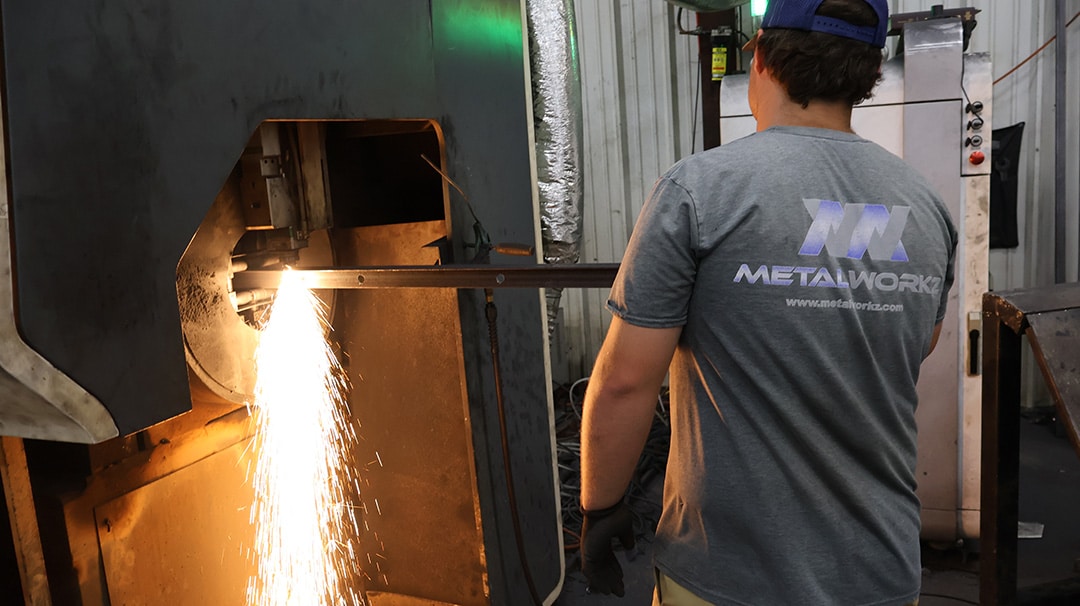
Laser cutting uses a high-powered laser beam to precisely cut through aluminum sheets and plates. The laser melts or vaporizes the material along a programmed cutting path, creating clean edges with minimal heat distortion.
When to Use Laser Cutting:
- Complex shapes with intricate details
- Tight tolerances (±0.005″ or better)
- Clean edges requiring minimal finishing
- Prototype parts or small production runs
- Parts with multiple holes, slots, or cutouts
The Metal Workz Advantage: Our fiber laser cutting systems handle aluminum from 24 gauge up to 1/2″ thick, producing parts with exceptional edge quality. The precision of laser cutting eliminates secondary operations, reducing costs and turnaround time. For a recent client in Nashville, we laser-cut 200 custom aluminum panels with intricate ventilation patterns—each identical to the CAD file within 0.003 inches.
Real Project Example: A regional HVAC contractor needed custom aluminum vent covers for a commercial building retrofit. Traditional stamping would have required expensive tooling. Instead, laser cutting allowed us to produce 75 unique sizes in three days, saving the client weeks of lead time and thousands in tooling costs.
Bending and Forming
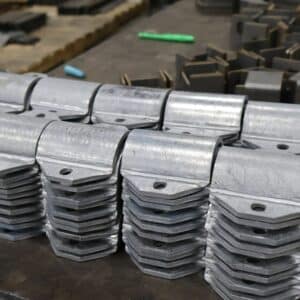 Metal bending shapes flat aluminum sheets into angles, channels, boxes, and complex three-dimensional forms. Press brakes apply controlled force to fold the metal along predetermined bend lines.
When to Use Bending:
- Creating boxes, enclosures, and brackets
- Forming angles and channels
- Achieving specific tolerances and bend radii
- Production of consistent, repeatable parts
The Process: Each material thickness and aluminum grade requires specific calculations for bend allowances and springback. Our experienced operators program these variables into CNC press brakes, ensuring each bend meets your exact specifications.
Metal Workz Capabilities: We bend aluminum up to 10 feet in length with precision control over bend angles (typically within 0.5 degrees). Our equipment handles everything from delicate 24-gauge panels to heavy 1/4″ plate.
Real Project Example: A Kentucky manufacturing plant needed custom aluminum guards for new production equipment. We fabricated 40 guards with multiple bends, each fitting precisely around existing machinery. The lightweight aluminum made installation easy while providing necessary safety protection.
Welding Aluminum
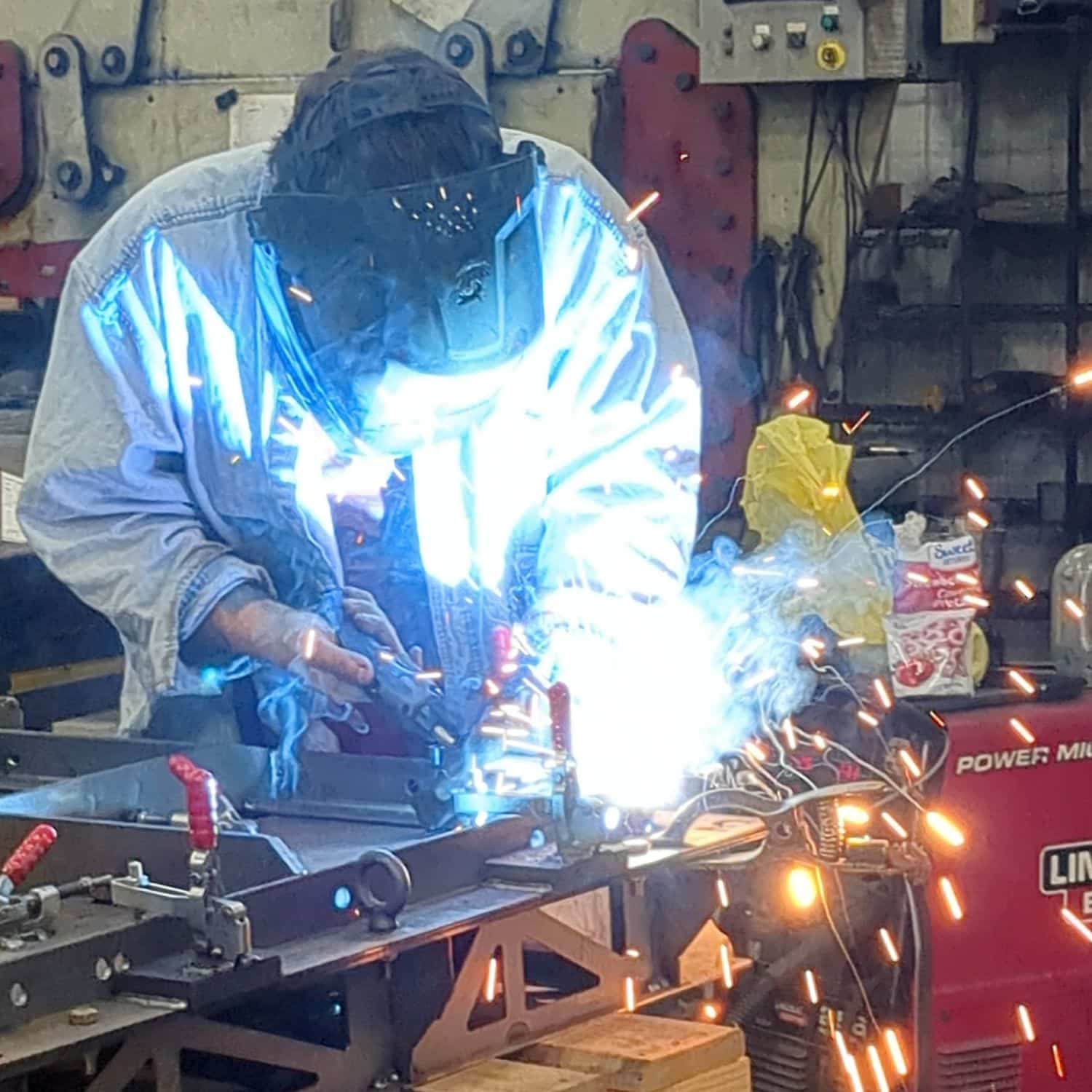
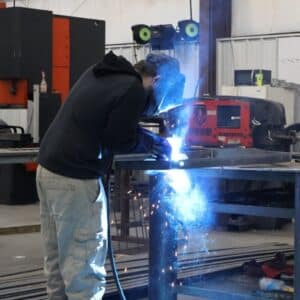 Welding permanently joins aluminum components by melting and fusing the base material. Aluminum welding requires specialized techniques because aluminum conducts heat rapidly and forms an oxide layer that must be removed during welding.
Primary Welding Methods:
TIG Welding (GTAC): Tungsten Inert Gas welding produces the cleanest, strongest welds on aluminum. An inert gas (typically argon) shields the weld from contamination while a non-consumable tungsten electrode creates the arc. TIG welding offers exceptional control and produces smooth, attractive welds ideal for visible applications.
MIG Welding (GMAW): Metal Inert Gas welding uses a continuously fed aluminum wire electrode. MIG welding works faster than TIG, making it economical for production welding and thicker materials. Modern MIG equipment produces high-quality aluminum welds suitable for structural applications.
When to Use Welding:
- Permanent assembly of components
- Structural applications requiring strength
- Creating watertight or airtight seals
- Joining dissimilar aluminum alloys
- Fabricating frames, enclosures, and assemblies
Metal Workz Expertise: Our certified welders specialize in aluminum welding techniques, producing strong, clean welds that meet or exceed industry standards. We weld aluminum in all positions and thicknesses, from thin 1/16″ material to heavy 1/2″ plate.
Real Project Example: A regional food processing facility needed custom aluminum tables and work surfaces. We welded aluminum frames and installed stainless steel tops, creating NSF-compliant work stations that resist corrosion in high-humidity washdown environments.
Powder Coating
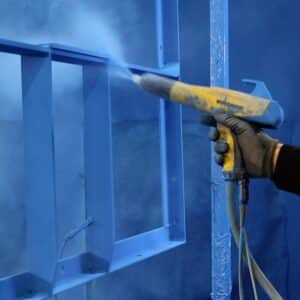 Powder coating applies a durable, attractive finish to aluminum parts. Unlike liquid paint, powder coating uses electrically charged powder particles that adhere to the metal surface. The coated parts are then cured in an oven, creating a hard, uniform finish.
Benefits of Powder Coating Aluminum:
- Superior durability compared to paint
- Excellent resistance to chipping, scratching, and fading
- Wide range of colors and textures
- Environmentally friendly (no VOCs)
- Enhanced corrosion protection
- Professional appearance
Common Powder Coating Colors: While any color is possible, popular choices for industrial applications include black, white, gray, and equipment-specific colors matching corporate branding.
Metal Workz Services: We offer complete powder coating services in-house, ensuring quality control from fabrication through finishing. This integrated approach reduces handling damage and speeds delivery.
Real Project Example: A Tennessee agricultural equipment dealer needed replacement panels for older equipment. We fabricated new aluminum panels and powder-coated them in the original equipment color, giving 10-year-old machinery a like-new appearance at a fraction of replacement cost.
Additional Fabrication Services
 Countersinking: Creating conical recesses around holes allows fasteners to sit flush with the surface. This improves appearance, prevents snagging, and protects fastener heads from damage. Countersinking is essential for applications where smooth surfaces matter—panel assemblies, access doors, and visible components.
Hardware Insertion: We install PEM fasteners—threaded inserts, studs, and standoffs—directly into aluminum parts during fabrication. This eliminates the need for tapping holes and provides stronger, more reliable threads in thin materials. Hardware insertion is particularly valuable for electronics enclosures and assemblies requiring multiple threaded mounting points.
Tapping: We cut internal threads in drilled holes, allowing bolts and screws to thread directly into aluminum components. CNC tapping ensures consistent thread depth and location across all parts. This service eliminates the hassle and potential for stripped threads from field tapping.
Tumbling: Tumbling removes burrs and sharp edges from laser-cut or machined aluminum parts. Parts are placed in a rotating barrel with ceramic media that gently smooths all edges and surfaces. The result is safe-to-handle parts with a uniform, slightly rounded edge profile.
Deburring: Our deburring process removes the small raised edges that remain after cutting or machining. Clean, burr-free parts look professional, prevent injury during handling, and allow proper fit in assemblies.
Design Services: Don’t have CAD files? No problem. Our design team can create manufacturing-ready drawings from sketches, photos, sample parts, or your verbal description. We’ll work with you to optimize designs for manufacturability, often reducing costs while improving performance.
Aluminum Grades: Choosing the Right Material
Not all aluminum is created equal. Here’s a quick comparison of common aluminum alloys:
| Grade | Strength | Best Properties | Ideal Applications | When to Choose |
|---|---|---|---|---|
| 1100-H14 | Lowest | Corrosion resistance, conductivity, easy forming | Heat exchangers, chemical equipment, decorative trim | Maximum corrosion resistance and conductivity matter more than strength |
| 3003-H14 | Moderate | Good formability, weldability, cost-effective | Storage tanks, enclosures, general sheet metal | Versatile general-purpose fabrication with balanced properties |
| 5052-H32 | High | Excellent corrosion resistance, best welding | Marine components, outdoor applications, tanks | Need corrosion resistance + strength + excellent welding |
| 6061-T6 | Highest | Maximum strength, excellent machinability | Structural frames, heavy-duty brackets, precision parts | Maximum strength required, heavy loads, extensive machining |
Detailed Grade Specifications
Grade 1100-H14: Pure Aluminum
Properties: Commercially pure (99% aluminum), excellent corrosion resistance, high thermal and electrical conductivity, easily formed
Strength: Lowest strength of common aluminum grades
Best Applications:
- Chemical processing equipment
- Heat exchangers and cooling fins
- Decorative trim and nameplates
- Food and beverage equipment
- Electrical conductors
When to Choose 1100: Select this grade when corrosion resistance and conductivity matter more than structural strength. It’s cost-effective for applications not requiring load-bearing capacity.
Grade 3003-H14: General Purpose Aluminum
Properties: Moderate strength, excellent formability, good corrosion resistance, readily welded
Strength: 20% stronger than 1100, suitable for general fabrication
Best Applications:
- Fuel tanks and storage vessels
- Chemical equipment
- Cabinet and enclosure panels
- Architectural trim
- General sheet metal work
When to Choose 3003: This versatile grade handles most general fabrication needs. It’s the workhorse of aluminum sheet metal, offering a good balance of formability, strength, and cost.
Real-World Example: We frequently use 3003 aluminum for custom equipment enclosures serving southern Kentucky industries. It forms easily around complex shapes while providing adequate strength for most applications.
Grade 5052-H32: Marine Grade Aluminum
Properties: Excellent corrosion resistance (especially saltwater), good formability, superior welding characteristics, moderate to high strength
Strength: Strongest non-heat-treatable aluminum alloy in common use
Best Applications:
- Marine components and boat parts
- Chemical drums and tanks
- Truck and trailer bodies
- Hydraulic lines and fittings
- Architectural panels
When to Choose 5052: Choose this grade for outdoor applications, marine environments, or anywhere maximum corrosion resistance is required. It’s also the best choice when you need both strength and excellent welding properties.
Grade 6061-T6: Structural Aluminum
Properties: Heat-treated for maximum strength, good corrosion resistance, excellent machinability, readily welded (though welding reduces heat-treated strength in the weld zone)
Strength: Highest strength of commonly available aluminum grades
Best Applications:
- Structural components and frames
- Heavy-duty brackets and supports
- Aircraft and aerospace parts
- Bicycle frames
- Automotive components
- Precision parts requiring machining
When to Choose 6061: Select this grade when maximum strength is required. It’s ideal for structural applications, heavy loads, or parts requiring extensive machining.
Important Note: Welding 6061-T6 reduces strength in the heat-affected zone. For welded structures requiring maximum strength, consider designing with 6061-T6 base material and 5356 or 4043 filler wire, or using mechanical fasteners instead of welding.
Selecting Your Aluminum Grade
Use this checklist when choosing aluminum:
☑ Strength Requirements
- What loads or forces will the part experience?
- Is this structural or decorative?
☑ Environment
- Indoor, outdoor, or marine conditions?
- Chemical exposure or extreme temperatures?
☑ Fabrication Methods
- Will it be welded, bent, or machined?
- Are complex shapes needed?
☑ Budget
- What’s your target price point?
- Is this a one-time or recurring order?
☑ Additional Factors
- Weight limitations or requirements
- Appearance and finish quality
- Regulatory or certification needs
Need Help Deciding? Our team can recommend the optimal aluminum grade based on your application requirements, budget, and performance needs. We’ve specified materials for hundreds of projects across diverse industries.
Industries We Serve with Aluminum Fabrication
Aluminum fabrication serves diverse industries across southern Kentucky, Tennessee, and surrounding states. Here’s how custom aluminum solutions solve real-world challenges:
Agricultural Equipment
Applications: Equipment frames, protective enclosures, storage bins, conveyor components, spray tank components, trailer modifications
Why Aluminum: Agricultural equipment operates in harsh outdoor conditions—rain, sun, fertilizers, and pesticides. Aluminum resists corrosion from these elements while reducing equipment weight. Lighter equipment means less soil compaction, better fuel economy, and easier manual handling of removable components.
Project Example: A Tennessee farm equipment dealer approached us with a problem—their popular grain cart was too heavy when fully loaded, causing rut damage in wet fields. We redesigned the side panels in 5052 aluminum, reducing overall weight by 280 pounds. The lighter cart reduced field compaction while maintaining structural integrity. Three years later, those aluminum panels show no signs of corrosion despite constant exposure to grain dust, moisture, and fertilizer residue.
Construction and Architectural
Applications: Decorative railings, structural supports, access panels, custom trim, HVAC ductwork, building facades
Why Aluminum: Construction projects value aluminum’s corrosion resistance, aesthetic appeal, and ease of installation. Aluminum doesn’t require painting, won’t rust, and can be powder-coated to match any color scheme. Lightweight components reduce structural loading and make installation safer and faster.
Project Example: A Bowling Green renovation project needed custom railings for an outdoor walkway. The architect specified powder-coated aluminum in a bronze finish. We fabricated 60 feet of railing with integrated LED lighting channels. The aluminum’s light weight allowed installation without reinforcing the existing structure, and the powder coating has maintained its appearance through two Kentucky winters.
Manufacturing and Industrial
Applications: Machine guards, custom brackets and fixtures, equipment housings, conveyor guides, production jigs, assembly tables
Why Aluminum: Manufacturers choose aluminum for machine components because it’s easy to modify, doesn’t create sparks (important in some environments), and can be anodized or powder-coated to match existing equipment. Its light weight makes installation and repositioning easier during equipment upgrades or layout changes.
Project Example: A Louisville automotive parts supplier needed custom guards for CNC machines. We fabricated clear polycarbonate and aluminum frame guards that provided safety protection while allowing operators to observe machining operations. The modular aluminum frames could be easily reconfigured when the facility added new equipment.
Automotive and Transportation
Applications: Truck bed liners and toolboxes, trailer components, custom brackets, fuel tank shields, running boards, roof racks
Why Aluminum: The transportation industry is rapidly adopting aluminum to reduce vehicle weight and improve fuel economy. Lighter trucks and trailers carry more payload within legal weight limits. Aluminum components don’t rust, eliminating the maintenance headaches common with steel.
Project Example: A regional delivery company needed lightweight toolboxes for their truck fleet. Off-the-shelf boxes were either too small or too heavy. We designed and fabricated custom aluminum toolboxes sized to their specific needs, with features like divided compartments and gas-spring lids. Each toolbox saved 35 pounds compared to steel alternatives, allowing the company to increase payload capacity across their entire fleet.
Small Business and Custom Projects
Applications: Prototype parts, one-off custom fabrications, replacement components, custom furniture, display fixtures, specialized tools
Why Aluminum: Small businesses and individuals often need custom solutions that aren’t available off-the-shelf. Aluminum fabrication makes these custom parts affordable because the material is easy to work with, doesn’t require expensive tooling, and can be finished to look professional.
Project Example: A local brewery needed custom tap handles featuring their logo. We laser-cut the logo design from 1/4″ aluminum plate and polished the pieces to a mirror finish. The distinctive tap handles helped their brand stand out at restaurants and bars carrying their products.
Another Example: A home workshop enthusiast needed a custom workbench with integrated tool storage. We fabricated an aluminum frame and sheet metal assembly that was lightweight enough to move around his shop yet sturdy enough for metalworking projects. Powder coating in charcoal gray gave it a professional appearance.
Why Choose a Local Aluminum Fabricator
When you need aluminum fabrication services, partnering with a regional fabricator offers significant advantages:
Local Fabrication Benefits at a Glance
✓ 2-3 weeks faster turnaround than national suppliers
✓ 20-40% savings on shipping costs
✓ Same-day response to questions and design changes
✓ No minimum order surprises or hidden fees
✓ On-site visits for complex projects
✓ Support local economy and regional jobs
Faster Turnaround Times
Local fabricators can complete your project weeks faster than distant suppliers. There’s no cross-country shipping, no delays at distribution centers, and no waiting for the next delivery truck. Rush jobs that require quick turnaround become manageable when your fabricator is a phone call and short drive away.
Real Impact: A construction project in Nashville needed replacement aluminum panels on short notice after the wrong size was delivered from an out-of-state supplier. We received their call on Tuesday morning, had the panels fabricated by Thursday afternoon, and the project stayed on schedule. With a distant supplier, they would have waited 2-3 weeks for reordering and shipping.
Personal Service and Direct Communication
Working with local fabricators means dealing directly with the people making your parts. You can discuss your project with experienced fabricators who understand your needs, not sales representatives reading from a script. Have a question during assembly? Call and talk to someone who remembers your project. Need a design change? Adjust the plan without navigating corporate bureaucracy.
Communication Advantage: When you explain your application to local fabricators, they often suggest improvements based on their regional experience. They understand local building codes, common practices in regional industries, and what works in the local climate and environment.
Cost Savings
While local fabrication might seem more expensive at first glance, the total project cost often favors nearby fabricators:
- No surprise shipping charges: Freight costs have skyrocketed. Shipping heavy aluminum fabrications across the country can add 20-40% to project costs.
- Reduced minimum quantities: Large suppliers often require minimum order quantities to justify setup costs. Local fabricators accommodate smaller orders economically.
- Less inventory needed: Fast turnaround means you don’t need to order extras “just in case” or maintain large inventories of custom parts.
- Easy returns and adjustments: If something isn’t quite right, you can handle it locally without shipping parts back and forth.
Flexibility and Customization
Local fabricators excel at custom work and project modifications. Need to adjust dimensions after seeing the first prototype? Add a late design feature? Modify parts during installation when field conditions differ from plans? Local fabricators can adapt quickly, keeping your project moving forward.
Flexibility Example: During installation of custom aluminum frames for a Kentucky warehouse, the contractor discovered that existing wall spacing varied more than architectural drawings indicated. We quickly re-measured, adjusted several frames, and had revised parts delivered the next day. A distant supplier would have required weeks for engineering change orders and remanufacturing.
Supporting Your Regional Economy
Choosing local fabricators keeps money in your community. Those businesses employ your neighbors, pay local taxes, and support other local suppliers. Many business owners prefer working with companies that invest in the local economy rather than sending profits out of state.
Easy Site Visits and Consultations
Complex projects often benefit from on-site visits. Can a fabricator visit your facility to measure existing equipment? Can you visit their shop to discuss your project in person? With local fabricators, the answer is yes—and it doesn’t require expensive travel or scheduling weeks in advance.
Site Visit Example: When a Nashville manufacturing facility needed custom guards for multiple machines, we sent a fabricator to measure and photograph each installation. On-site observation revealed details that drawings missed, resulting in parts that fit perfectly the first time.
Why Metal Workz for Your Aluminum Fabrication Projects
Based in southern Kentucky, Metal Workz combines advanced fabrication technology with personalized service. Here’s what sets us apart:
Comprehensive Capabilities Under One Roof
We handle every step of aluminum fabrication in-house:
- Laser cutting (up to 1/2″ thick aluminum)
- Precision bending and forming
- TIG and MIG welding
- Powder coating and finishing
- Hardware installation
- Assembly and packaging
Keeping everything in-house ensures quality control, reduces lead times, and simplifies coordination. You work with one company from design through delivery.
No Project Too Large or Too Small
Whether you need a single prototype part or thousands of production pieces, Metal Workz delivers:
Small Projects: Custom one-off fabrications for individuals and small businesses receive the same attention as large orders. We understand that today’s prototype might become tomorrow’s production run.
High-Volume Production: We have the capacity and expertise to produce consistent, high-quality parts in quantities from dozens to thousands. Our process controls ensure part-to-part consistency throughout production runs.
Flexibility: Need 10 parts now and 100 more in three months? No problem. We can set up projects for repeat production without requiring large initial quantities.
Quick Turnaround Without Compromising Quality
Speed matters when you’re facing deadlines or unexpected problems. Our typical turnaround times:
- Simple laser cutting: 1-3 business days
- Bent/formed parts: 3-5 business days
- Welded assemblies: 1-2 weeks
- Complete fabrications with powder coating: 2-3 weeks
Rush services available for urgent needs—just ask.
Experienced Team
Our fabrication team brings decades of combined metalworking experience. We’ve tackled challenges across diverse industries and applications, learning what works and what doesn’t. This experience helps us:
- Suggest design improvements that reduce costs or improve performance
- Identify potential fabrication issues before cutting material
- Recommend optimal materials and processes for your application
- Troubleshoot installation or assembly challenges
Serving Southern Kentucky and Beyond
While based in Albany, Kentucky, we serve clients throughout:
- Southern and Central Kentucky
- Northern Tennessee
- Southern Indiana
- And throughout the United States via our shipping network
Located near major transportation routes, we can efficiently ship finished parts throughout the region and beyond.
Competitive Pricing
We price projects fairly based on material, labor, and complexity—no hidden fees or surprise charges. Request a quote and you’ll receive clear, detailed pricing showing exactly what you’re paying for. We work within your budget, suggesting cost-effective alternatives when appropriate.
How to Get Started with Your Aluminum Fabrication Project
Ready to turn your aluminum fabrication idea into reality? Here’s the process:
Typical Project Timeline
| Phase | Timeline | What Happens |
|---|---|---|
| Initial Consultation | Same day | Discuss requirements, review designs, understand needs |
| Quote Provided | 24-48 hours | Detailed pricing with materials, labor, lead time |
| Design Review | 2-3 days | Optimize for manufacturing, suggest improvements |
| Prototype (if needed) | 1 week | Verify fit and function before production |
| Production | 1-3 weeks | Fabrication based on complexity |
| Finishing | 3-5 days | Powder coating, assembly, quality checks |
| Delivery | 1-3 days local | Packaging and shipping or pickup |
Step 1: Initial Consultation
Contact Metal Workz by phone at (931) 854-5000, visit our website at https://metalworkz.com/contact/, or stop by our Albany, Kentucky facility at 368 KY-90 East.
During the initial consultation, we’ll discuss:
- Your project requirements and applications
- Desired materials and finishes
- Quantity needed
- Timeline expectations
- Budget parameters
This conversation helps us understand your needs and propose the best fabrication approach.
Step 2: Design Review
If you have CAD files, drawings, or sketches, send them over. We’ll review your designs and may suggest modifications to:
- Optimize manufacturability
- Reduce material costs
- Improve structural performance
- Simplify assembly
- Enhance durability
Don’t have formal drawings? No problem. We can work from:
- Hand sketches with dimensions
- Photos of existing parts
- Sample parts to duplicate
- Verbal descriptions of your needs
Our design team will create manufacturing-ready drawings for your approval before we begin fabrication.
Step 3: Quotation
Based on your requirements, we’ll provide a detailed quote including:
- Material costs
- Fabrication labor
- Finishing (powder coating, etc.)
- Any special processes or hardware
- Lead time estimate
- Shipping (if applicable)
Quotes are typically provided within 24-48 hours for straightforward projects. Complex fabrications requiring engineering review may take a few days longer.
Step 4: Prototype or Production
For complex projects or new designs, we often recommend starting with a prototype. This allows you to verify fit, function, and appearance before committing to full production. Prototyping catches potential issues early, saving time and money.
Once the design is approved, we proceed with production. Throughout the fabrication process, we maintain quality controls ensuring every part meets specifications.
Step 5: Finishing and Delivery
After fabrication, parts move to finishing (if specified). Our powder coating process adds durability and appearance. We can match nearly any color and accommodate special finish requirements like texture or gloss level.
Finished parts are carefully packaged to prevent damage during shipping. Local customers can arrange pickup at our facility or we can deliver to your location. For distant customers, we work with reputable freight carriers to ensure safe, timely delivery.
What to Prepare Before Requesting a Quote
Help us provide an accurate quote quickly with this information:
✓ Project Details Checklist
- [ ] What you’re making (enclosure, bracket, panel, assembly, etc.)
- [ ] How it will be used (indoor, outdoor, structural, decorative)
- [ ] Environmental conditions (temperature, moisture, chemicals)
✓ Specifications Checklist
- [ ] Dimensions and tolerances
- [ ] Material preferences (or “recommend best option”)
- [ ] Finish requirements (powder coat color, polished, raw)
- [ ] Quantity needed (even rough estimates help)
- [ ] Special requirements (certifications, testing, packaging)
✓ Timeline & Budget
- [ ] When do you need completed parts?
- [ ] One-time order or ongoing production?
- [ ] Any critical deadlines?
- [ ] Target price or budget constraints?
Don’t have all the answers? That’s completely fine—we’ll guide you through these decisions during our consultation. The more information you provide upfront, the more accurately we can quote your project.
Frequently Asked Questions About Aluminum Fabrication
How much does aluminum fabrication cost?
Aluminum fabrication costs vary based on complexity, material, quantity, and finishing. Here’s a general pricing guide:
Typical Price Ranges (Small Quantities)
| Project Type | Price Range | Example |
|---|---|---|
| Simple laser-cut parts | $10-50 each | Flat brackets, panels, simple shapes |
| Bent/formed components | $25-100 each | Enclosure panels, angles, guards |
| Welded assemblies | $100-500 each | Frames, multi-part assemblies |
| Complex assemblies with coating | $200-1000+ each | Complete enclosures, structural frames |
Volume pricing significantly reduces per-piece costs (often 30-50% less for orders of 100+ pieces)
Cost-Saving Strategies
✓ Increase quantity → Volume pricing reduces per-part costs
✓ Simplify designs → Fewer bends, welds, features = lower labor
✓ Use standard sizes → Reduces material waste
✓ Single-color coating → Multiple colors add setup costs
✓ Allow lead time → Rush charges add 20-40%
Best approach: Request a detailed quote for your specific project. We provide transparent pricing showing material, labor, and finishing costs.
What’s the minimum order quantity?
Metal Workz accommodates both small custom projects and high-volume production. We have no formal minimum order quantity—we’ve fabricated single prototype parts and production runs of thousands.
That said, some setup operations have fixed costs that get divided across the order. Very small quantities of complex parts may have higher per-piece costs. We’ll always be transparent about pricing and suggest economical alternatives when appropriate.
How long does a typical project take?
Timeline depends on project complexity and current shop workload:
- Simple parts (laser cutting only): 1-3 business days
- Moderate complexity (cutting + bending): 3-5 business days
- Complex fabrications (welding, assembly): 1-2 weeks
- Complete projects with finishing: 2-3 weeks
Rush service available for urgent needs—contact us to discuss expedited options.
We provide estimated completion dates with every quote. Once production begins, we’ll update you on progress and alert you immediately if any issues arise.
Can you work from my design files?
Yes! We accept most common file formats:
- CAD files (.DXF, .DWG, .STEP, .IGES)
- PDF drawings
- Hand sketches with dimensions
- Photos of existing parts
- Sample parts to duplicate
If your files need conversion or cleanup for manufacturing, we’ll handle that. We’ll also review designs for any potential fabrication issues and suggest improvements before cutting material.
Don’t have CAD files? Our design team can create manufacturing-ready drawings from sketches, photos, or your verbal description of what you need.
Do you offer design services?
Absolutely. Our design team helps customers every day. We can:
- Create CAD drawings from sketches or descriptions
- Reverse-engineer existing parts
- Optimize designs for manufacturability
- Suggest design improvements based on fabrication experience
- Develop prototypes to test form and function
Design services are often included in your project quote. For extensive custom design work, we may quote design time separately.
What’s the difference between aluminum and steel fabrication?
Here’s a quick comparison:
| Factor | Aluminum | Steel |
|---|---|---|
| Weight | 1/3 the weight of steel | Heavier—baseline comparison |
| Corrosion | Naturally rust-resistant | Requires coating/treatment |
| Strength | Good strength-to-weight ratio | Generally stronger per volume |
| Workability | Easier to cut, form, weld | Requires more power/heat |
| Material Cost | Higher per pound | Lower per pound |
| Total Cost | Often lower (easier fabrication, no rust treatment, reduced shipping) | Higher when factoring all costs |
| Best Uses | Corrosive environments, weight-critical applications, electrical conductivity | Maximum strength, high temperatures, lowest material cost |
Quick Decision Guide:
- Choose aluminum for: Outdoor use, transportation, food equipment, weight matters, electrical needs
- Choose steel for: Heavy loads, high heat, maximum strength, stationary applications
Can you powder coat aluminum parts?
Yes! Powder coating is one of our core services. We offer powder coating in virtually any color, with options for different textures and gloss levels.
Powder coating aluminum provides excellent durability, weather resistance, and appearance. The finish resists chipping, scratching, and fading far better than paint. We powder coat in-house, ensuring consistent quality and color matching across all parts in your order.
Popular powder coat colors for industrial applications include black, white, light gray, dark gray, and safety yellow. We can also match specific corporate colors or equipment paint schemes—just provide a sample or color code.
Do you ship outside Kentucky?
Yes. While most of our customers are located in Kentucky, Tennessee, and surrounding states, we regularly ship completed fabrications throughout the United States.
We work with reputable freight carriers to ensure your parts arrive safely and on time. We can arrange shipping to your facility or job site, and we’ll provide tracking information so you know when to expect delivery.
For local customers (within 2-hour drive), we may be able to provide direct delivery for large orders or complex assemblies that shouldn’t be subjected to commercial freight handling.
What if my parts don’t fit or aren’t quite right?
Customer satisfaction is our top priority. If fabricated parts don’t meet your specifications or expectations:
- Contact us immediately: The sooner we know about issues, the faster we can resolve them
- We’ll evaluate the problem: Is it a fabrication error or a design issue?
- We’ll propose solutions: Remake parts, modify designs, or adjust remaining production
If we made an error (wrong dimensions, incorrect material, etc.), we’ll remake the parts at no additional charge. If the issue stems from design specifications, we’ll work with you to develop solutions, often at reduced cost for revised parts.
Prevention is always better than correction. That’s why we:
- Review all designs before fabrication begins
- Recommend prototypes for complex or untested designs
- Maintain open communication throughout projects
- Check parts against specifications before finishing and delivery
How do I maintain aluminum fabrications?
One of aluminum’s greatest advantages is low maintenance. For most applications:
Unpainted Aluminum: Wash periodically with mild soap and water. The natural oxide layer protects against corrosion, so no special treatments are needed.
Powder-Coated Aluminum: Wash with soap and water as needed. Avoid abrasive cleaners that could scratch the coating. Touch up any chips or scratches to prevent underlying corrosion in harsh environments.
Architectural Aluminum: For visible architectural applications, clean 1-2 times per year. Use soft brushes or cloths—never steel wool or abrasive pads which can scratch the finish.
Aluminum doesn’t require painting, rust treatments, or other maintenance common with steel. This makes it ideal for hard-to-access installations or environments where ongoing maintenance would be difficult or expensive.
Ready to Start Your Aluminum Fabrication Project?
Whether you need a single custom part or production volumes, Metal Workz delivers quality, service, and expertise.
Why Choose Metal Workz?
✓ Complete in-house capabilities (laser cutting to powder coating)
✓ No minimum order quantities
✓ Fast turnaround (1-3 weeks typical)
✓ Serving Kentucky, Tennessee, and nationwide
✓ Both small custom jobs and high-volume production
✓ Free design consultation and quotes
Get Your Free Quote Today
📞 Call: (931) 854-5000
🌐 Online: https://metalworkz.com/contact/
📍 Visit: 368 KY-90 East, Albany, KY 42602
What to expect:
- Quick response (usually same day)
- Free consultation about your project
- Detailed quote within 24-48 hours
- No pressure, no hidden fees
From simple laser-cut parts to complex welded assemblies with custom powder coating, Metal Workz transforms your aluminum fabrication ideas into reality.
Let’s build something great together.
Metal Workz LLC proudly serves southern Kentucky, northern Tennessee, and clients throughout the United States with professional aluminum fabrication services. All our products are fabricated in the USA using quality materials and proven processes.