What is MIG Welding?
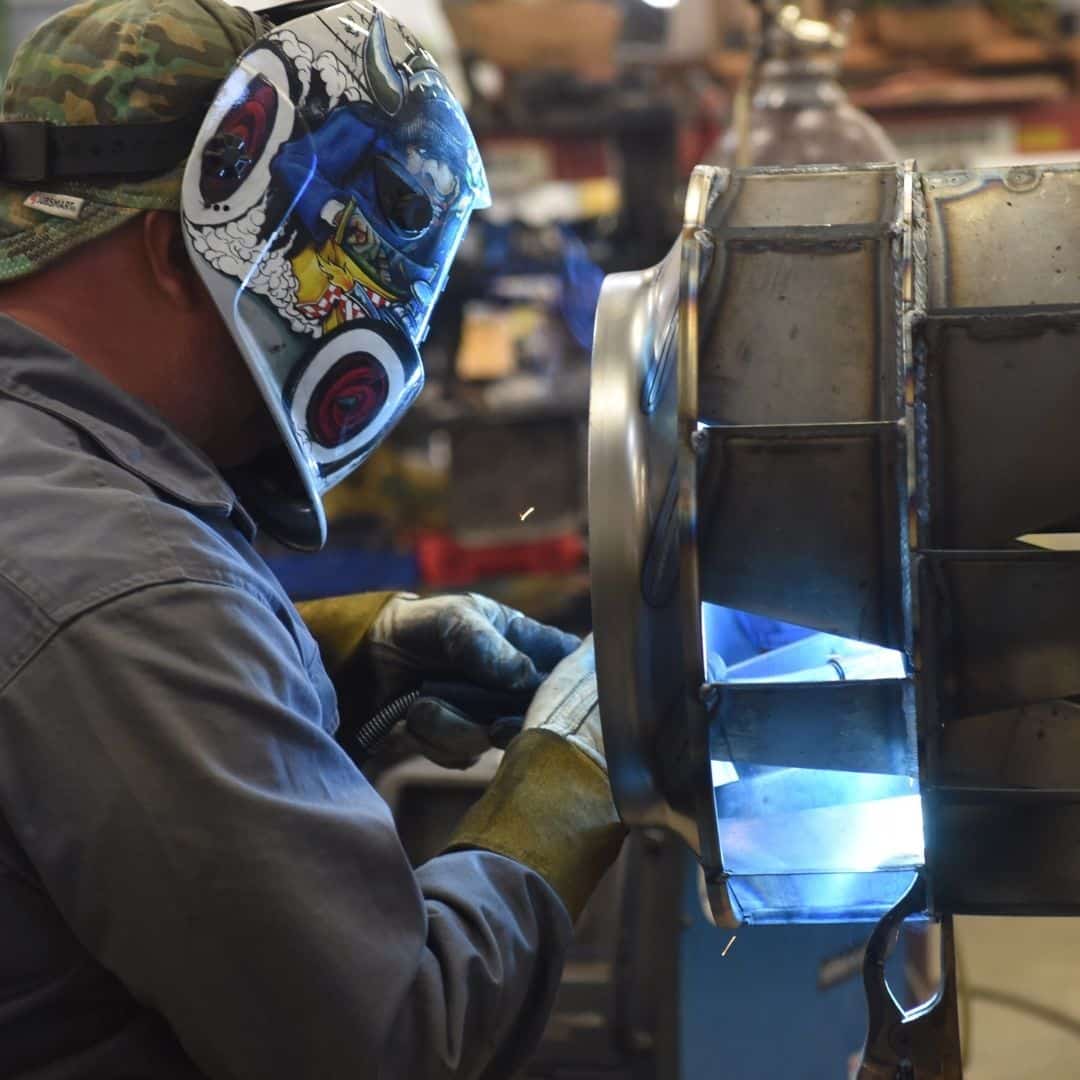
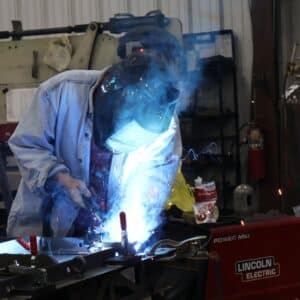
MIG (Metal Inert Gas) welding, also known as GMAW (Gas Metal Arc Welding), is a versatile welding process that uses a continuously fed wire electrode to join metal components. A shielding gas protects the weld from atmospheric contamination, creating strong, clean welds suitable for both production and custom fabrication.
MIG vs TIG Welding: Quick Comparison
| Factor | MIG Welding | TIG Welding |
|---|---|---|
| Speed | Fast – ideal for production | Slower – precise work |
| Ease of Use | Easier to learn, less training | Requires significant skill |
| Weld Appearance | Good, clean welds | Excellent, smoothest finish |
| Material Thickness | Best for thicker materials (1/8″+) | Excellent for thin materials |
| Cost | Lower labor costs | Higher labor costs |
| Best For | Production runs, structural welding | Precision work, visible welds, thin materials |
| Aluminum Welding | Good for thicker aluminum | Best for thin aluminum, critical welds |
Why Choose MIG Welding?
✓ 3-4X faster than TIG welding for production work
✓ Lower cost per weld due to speed and efficiency
✓ Versatile – works on steel, stainless, and aluminum
✓ Strong welds suitable for structural applications
✓ Less cleanup compared to stick welding
✓ Production-ready for both single parts and volume runs
MIG Welding Services: What We Offer
Our MIG Welding Capabilities
| Service | Materials | Thickness Range | Typical Applications |
|---|---|---|---|
| Production MIG Welding | Steel, stainless, aluminum | 1/8″ to 1/2″ | Frames, assemblies, brackets |
| Structural Welding | Carbon steel, alloy steel | 1/4″ to 3/4″ | Equipment frames, supports |
| Aluminum MIG Welding | 3003, 5052, 6061 alloys | 1/8″ to 3/8″ | Enclosures, tanks, panels |
| Stainless Steel MIG | 304, 316 stainless | 1/8″ to 1/2″ | Food equipment, corrosion-resistant parts |
| Custom Fabrication | Mixed materials | Varies | One-off projects, prototypes |
Industries We Serve
 Agricultural Equipment
- Equipment frames and chassis
- Implement brackets and mounts
- Trailer components
- Storage bin assemblies
Construction & Structural
- Building frames and supports
- Stairways and railings
- Structural steel assemblies
- Heavy equipment components
Manufacturing & Industrial
- Machine frames and guards
- Conveyor systems
- Custom fixtures and jigs
- Production assemblies
Transportation
- Truck bed frames
- Trailer construction
- Running boards and steps
- Vehicle brackets and mounts
Custom Projects
- One-off fabrications
- Prototype assemblies
- Repair and modification work
- Specialty welding projects
The MIG Welding Process: How It Works
Step-by-Step MIG Welding
| Phase | What Happens | Purpose |
|---|---|---|
| 1. Design Review | Analyze drawings, specifications | Ensure weldability, identify challenges |
| 2. Material Preparation | Clean surfaces, fit-up parts | Remove contaminants, ensure proper fit |
| 3. Welding Setup | Select wire, gas, voltage, speed | Optimize parameters for material/thickness |
| 4. Tack Welding | Temporary welds to hold alignment | Position parts before final welding |
| 5. Final Welding | Complete welds per specifications | Create strong, permanent joints |
| 6. Quality Inspection | Visual inspection, testing if required | Verify weld quality and strength |
What Makes Quality MIG Welds?
 ✓ Proper penetration – Weld fully fuses with base material
✓ Consistent bead – Uniform appearance without defects
✓ No porosity – Gas shielding prevents air pockets
✓ Correct heat input – Avoids warping or burn-through
✓ Clean prep – Contaminant-free surfaces
✓ Skilled welder – Experience matters for complex joints
Materials We MIG Weld
Steel MIG Welding
Carbon Steel – Most common MIG welding application
- Mild steel (A36, 1018, 1020)
- Structural steel shapes (angles, channels, beams)
- Sheet metal (16 gauge to 1/2″ plate)
- Tube and pipe
Best For: General fabrication, structural assemblies, equipment frames, brackets
Advantages: Easy to weld, strong results, cost-effective, readily available
Stainless Steel MIG Welding
304 Stainless – General purpose stainless
- Corrosion resistant
- Food-safe applications
- Moderate strength
316 Stainless – Marine grade stainless
- Superior corrosion resistance
- Chemical resistant
- Marine and saltwater environments
Best For: Food processing equipment, marine applications, chemical equipment, architectural elements
Considerations: Requires special wire and gas mix (tri-mix), more expensive than carbon steel
Aluminum MIG Welding
Common Aluminum Alloys for MIG:
| Alloy | MIG Weldability | Best Applications | Notes |
|---|---|---|---|
| 3003 | Excellent | Tanks, enclosures, general fabrication | Most forgiving for MIG welding |
| 5052 | Excellent | Marine, outdoor, structural | Best combination strength + weldability |
| 6061 | Good | Structural frames, heavy-duty assemblies | Loses some strength in weld zone |
| 1100 | Excellent | Non-structural, decorative | Very soft, limited strength |
Aluminum MIG Advantages:
- Faster than TIG for thicker aluminum (3/16″+)
- Higher deposition rates
- Good for production welding
- Lower skill requirement than TIG
When to Choose TIG Over MIG for Aluminum:
- Thin material (under 1/8″)
- Visible, cosmetic welds
- Critical structural joints
- Maximum weld quality required
Material Selection Guide
Choose Your Material Based On:
☑ Environment
- Outdoor/weather → Aluminum or stainless
- Indoor/dry → Carbon steel acceptable
- Marine/saltwater → 5052 aluminum or 316 stainless
- Chemical exposure → Stainless steel
☑ Strength Requirements
- Light duty → 3003 aluminum or mild steel
- Structural → 6061 aluminum or structural steel
- Heavy duty → Alloy steel or thick aluminum
☑ Weight Considerations
- Weight critical → Aluminum (1/3 weight of steel)
- Weight not important → Steel (lower material cost)
☑ Budget
- Lowest cost → Carbon steel
- Moderate → Aluminum 3003 or 5052
- Higher cost → Stainless steel, 6061 aluminum
MIG Welding Applications & Project Examples
Structural Frames & Assemblies
What We Build:
- Equipment frames and chassis
- Support structures and bracing
- Platform assemblies
- Machinery bases
Why MIG Welding: Fast, strong welds suitable for structural loads. Production-efficient for multiple identical frames.
Project Example: A Tennessee agricultural equipment dealer needed frames for a new seed planter design. We MIG welded 50 identical steel frames with precise fixturing, ensuring each frame matched specifications within 1/8″. MIG welding speed allowed us to complete the production run in one week versus three weeks with TIG.
Enclosures & Cabinets
What We Build:
- Control panel enclosures
- Electrical cabinets
- Equipment housings
- Protective guards
Why MIG Welding: Clean welds on thin to medium sheet metal. Fast enough for production quantities.
Project Example: A Louisville manufacturing plant needed 25 aluminum electrical enclosures for new CNC machines. MIG welding allowed us to produce consistent, clean welds on 1/8″ aluminum sheet. The enclosures featured welded corners and mounting brackets, all completed with powder-coated finish.
Trailer Components & Modifications
What We Build:
- Trailer frames and tongue assemblies
- Side rails and cross members
- Ramp systems
- Custom brackets and mounts
Why MIG Welding: Ideal for heavy structural steel in trailer construction. Fast enough for commercial trailer production.
Project Example: A regional delivery company needed to modify 15 utility trailers with custom aluminum toolboxes and equipment racks. We MIG welded the mounting brackets to existing trailer frames and fabricated aluminum storage boxes. Steel-to-aluminum welding required careful parameter control, which our experienced welders handle routinely.
Agricultural Equipment Repairs & Custom Parts
What We Build:
- Replacement brackets and mounts
- Modified components
- Repair welds on damaged equipment
- Custom attachments
Why MIG Welding: Versatile enough for repair work and strong enough for demanding agricultural applications.
Project Example: A Kentucky farm needed custom brackets to mount GPS equipment on an older tractor model. We designed and MIG welded heavy-duty steel brackets that bolt to existing frame points without modification. The farmer installed them in 30 minutes and the brackets have withstood three years of field use.
Production Welding
What We Build:
- Repeated identical assemblies
- High-volume component production
- Fixture-welded parts
- Consistent multi-piece assemblies
Why MIG Welding: Speed and repeatability make MIG ideal for production. Consistent parameters ensure part-to-part uniformity.
Project Example: An industrial supplier needed 200 steel mounting brackets per month. We developed welding fixtures that position parts consistently, allowing our welders to produce uniform parts efficiently. MIG welding speed means we complete each month’s order in two days, maintaining cost-effective pricing.
Why Choose Professional MIG Welding Services
DIY vs Professional Welding
| Factor | DIY Approach | Professional Services |
|---|---|---|
| Equipment Investment | $500-2000+ for MIG welder | No equipment purchase needed |
| Skill Development | Weeks to months of practice | Experienced welders immediately |
| Weld Quality | Inconsistent until experienced | Consistent, high-quality results |
| Time Required | Learning curve + project time | Fast turnaround, no learning curve |
| Complex Projects | Limited by skill/equipment | Full capabilities available |
| Material Waste | Higher during learning | Minimal waste from experience |
| Best For | Hobbyists, ongoing maintenance | Production, critical welds, time-sensitive projects |
Benefits of Professional MIG Welding
Certified Welders
- Years of experience across materials
- Trained in proper techniques and safety
- Understand metallurgy and heat control
- Troubleshoot complex welding challenges
Quality Equipment
- Industrial-grade MIG welders
- Precise voltage and wire feed control
- Quality consumables (wire, gas, nozzles)
- Proper fixturing and jigs
Consistent Results
- Part-to-part uniformity in production
- Documented welding procedures
- Quality control processes
- Repeatable specifications
Material Knowledge
- Recommend optimal materials for application
- Source quality metals at competitive prices
- Understand how different alloys weld
- Advise on design for weldability
Time Savings
- Fast turnaround on projects
- No learning curve or trial-and-error
- Efficient production setups
- Meet deadlines reliably
MIG Welding vs Other Welding Methods
Complete Welding Process Comparison
| Process | Speed | Aluminum | Steel | Skill Level | Cost | Best Applications |
|---|---|---|---|---|---|---|
| MIG | Fast | Good (thicker) | Excellent | Moderate | $$ | Production, structural, general fabrication |
| TIG | Slow | Excellent | Excellent | High | $$$ | Precision, thin materials, visible welds |
| Stick | Moderate | Poor | Good | Moderate | $ | Field repairs, thick steel, outdoor welding |
| Flux Core | Fast | Not suitable | Good | Moderate | $$ | Outdoor structural, windy conditions |
When to Choose Each Method
Choose MIG Welding For:
- Production welding (multiple identical parts)
- Structural steel assemblies
- Medium to thick aluminum (1/8″+)
- General fabrication shop work
- Projects requiring speed and economy
- Welding in controlled shop environment
Choose TIG Welding For:
- Thin materials (under 1/8″)
- Aluminum requiring best quality
- Visible, cosmetic welds
- Critical structural welds on aluminum
- Precision work with tight specifications
- Exotic metals (titanium, magnesium)
Choose Stick Welding For:
- Field repairs and outdoor work
- Thick structural steel
- Rusty or contaminated surfaces
- Windy or adverse conditions
- Situations where portability matters
MIG Welding Quality & Standards
Quality Assurance Process
✓ Pre-Weld Inspection
- Material verification
- Surface cleanliness check
- Proper fit-up confirmation
- Joint design review
✓ During Welding
- Parameter monitoring
- Visual inspection of bead formation
- Proper sequence and technique
- Heat control
✓ Post-Weld Inspection
- Visual inspection for defects
- Dimensional verification
- Penetration and fusion check
- Additional testing if specified
Common Weld Defects We Prevent
| Defect | Cause | Prevention |
|---|---|---|
| Porosity | Air/moisture contamination | Clean materials, proper gas flow |
| Lack of Fusion | Insufficient heat | Correct voltage, proper speed |
| Undercut | Excessive heat/speed | Controlled parameters, technique |
| Warping | Too much heat input | Proper sequencing, heat management |
| Cracking | Stress, contamination | Correct filler, clean materials |
| Spatter | Improper settings | Optimize voltage/wire speed |
Testing & Certification
Visual Inspection (Standard on all projects)
- Weld appearance and uniformity
- No visible cracks or defects
- Proper penetration indicators
- Dimensional accuracy
Destructive Testing (Available on request)
- Bend tests
- Tensile strength tests
- Hardness testing
- Sample sectioning
Non-Destructive Testing (Available for critical applications)
- Dye penetrant inspection
- Ultrasonic testing
- X-ray inspection (for pressure vessels, critical structural)
Certifications:
- Welder certifications available on request
- AWS (American Welding Society) procedures
- ASME certified welding for pressure applications
- Documentation for regulated industries
MIG Welding Services: Pricing & Lead Times
Typical Pricing Structure
Welding services are typically priced by:
☑ Labor Time
- Welder hourly rate
- Setup and fixturing time
- Complexity of joints
- Number of welds per part
☑ Materials
- Base metal cost
- Filler wire
- Shielding gas
- Consumables
☑ Quantity
- Single parts: Higher per-piece cost
- Production runs: Lower per-piece cost
- Setup costs divided across quantity
☑ Additional Services
- Fabrication/cutting before welding
- Grinding and finishing after welding
- Powder coating or other finishing
Cost Comparison Guide
| Project Type | Typical Cost Range | Lead Time |
|---|---|---|
| Simple brackets (2-3 welds) | $25-75 each | 3-5 days |
| Equipment frames (multiple welds) | $150-500 each | 1-2 weeks |
| Production welding (per part in qty 50+) | $15-100 each | 2-3 weeks |
| Large assemblies (complex, multiple parts) | $500-2000+ each | 2-4 weeks |
| Trailer modifications | $300-1500 per trailer | 1-2 weeks |
Volume Discounts:
- 10-25 pieces: 10-15% reduction per piece
- 25-100 pieces: 20-30% reduction per piece
- 100+ pieces: Custom production pricing
Lead Time Factors
Affects Turnaround:
- Current shop workload
- Project complexity
- Material availability
- Quantity ordered
- Finishing requirements
Standard Lead Times:
- Simple welding projects: 3-5 business days
- Medium complexity: 1-2 weeks
- Production runs: 2-3 weeks
- Large complex assemblies: 3-4 weeks
Rush Services Available – Contact us for expedited scheduling options.
Metal Workz MIG Welding Services
Why Choose Metal Workz for MIG Welding
✓ Experienced Welding Team
- Decades of combined welding experience
- Proficient in steel, stainless, and aluminum MIG welding
- Certified welders for structural and critical applications
- Problem-solvers who handle complex challenges
✓ Quality Equipment & Processes
- Industrial MIG welding machines
- Precision fixtures for production consistency
- Quality shielding gas and filler materials
- In-process quality controls
✓ Complete Fabrication Services
- Laser cutting before welding
- Bending and forming
- Welding (MIG and TIG capabilities)
- Powder coating and finishing
- Assembly and packaging
✓ Flexible Service Model
- Single custom welds to production runs
- Prototype development
- Repair and modification work
- Design consultation available
✓ Southern Kentucky Location
- Fast turnaround for regional customers
- Lower shipping costs than national suppliers
- Personal service and direct communication
- Easy site visits for complex projects
Our MIG Welding Capabilities
| Capability | Specification |
|---|---|
| Materials | Steel, stainless steel, aluminum alloys |
| Thickness Range | 1/8″ to 3/4″ depending on material |
| Max Weldment Size | Limited only by positioning equipment |
| Production Capacity | Single parts to high-volume production |
| Welding Positions | All positions (flat, horizontal, vertical, overhead) |
| Quality Standards | AWS procedures, visual inspection standard |
From Regional Farms to Industrial Manufacturers
Small Businesses & Individuals
- Custom one-off welding projects
- Equipment repairs and modifications
- Prototype development
- No minimum order requirements
Agricultural Operations
- Equipment frame repairs
- Custom implement brackets
- Trailer modifications
- Replacement component fabrication
Manufacturers & Contractors
- Production welding runs
- Structural assemblies
- OEM component fabrication
- Consistent quality and delivery
Industrial & Commercial
- Equipment frameworks
- Safety guards and barriers
- Material handling components
- Custom industrial assemblies
How to Get Started with MIG Welding Services
Quick Start Guide
| Step | What You Need | Timeline |
|---|---|---|
| 1. Initial Contact | Description of project, rough quantities | Same day response |
| 2. Quote Request | Drawings/sketches, specifications, delivery needs | Quote in 24-48 hours |
| 3. Design Review | Review recommendations, approve approach | 1-2 days |
| 4. Order Placement | PO or deposit, finalize details | Production starts |
| 5. Welding & Fabrication | We manufacture to spec | 1-3 weeks typical |
| 6. Quality Check & Delivery | Final inspection, packaging, ship/pickup | On schedule |
What to Prepare Before Requesting a Quote
✓ Project Information
- [ ] What needs to be welded (materials, thicknesses)
- [ ] Type of joint (butt weld, fillet weld, lap joint, etc.)
- [ ] How the parts will be used (structural, decorative, etc.)
- [ ] Environment (indoor, outdoor, corrosive conditions)
✓ Specifications
- [ ] Drawings, sketches, or photos
- [ ] Dimensions and tolerances
- [ ] Material preferences or “recommend best option”
- [ ] Finish requirements (as-welded, ground smooth, painted, powder coated)
✓ Quantity & Timeline
- [ ] How many parts needed?
- [ ] When do you need them?
- [ ] One-time project or recurring production?
- [ ] Any critical deadlines?
✓ Additional Services
- [ ] Do parts need fabrication before welding? (cutting, bending)
- [ ] Finishing requirements? (grinding, coating)
- [ ] Assembly needed?
- [ ] Special testing or certification required?
Don’t Have All Details? We’ll help you work through the specifics during our consultation.
Frequently Asked Questions About MIG Welding Services
What materials can you MIG weld?
We MIG weld:
- Carbon steel (mild steel, structural steel, plate)
- Stainless steel (304, 316)
- Aluminum (3003, 5052, 6061)
For each material, we use appropriate filler wire and shielding gas to ensure quality welds. We can also weld dissimilar materials in some cases (steel to aluminum requires special techniques).
How much does MIG welding cost?
MIG welding costs depend on:
- Complexity of joints
- Material and thickness
- Number of welds per part
- Quantity ordered
- Additional services needed
Typical ranges:
- Simple bracket welding: $25-75
- Frame assembly: $150-500
- Production welding (qty 50+): $15-100 per piece
Request a quote for accurate pricing on your specific project. We provide detailed quotes showing labor, materials, and finishing costs.
What’s the difference between MIG and TIG welding?
MIG Welding:
- Faster welding speed
- Better for thicker materials
- Lower cost per weld
- Good quality results
- Easier to learn
TIG Welding:
- Slower, more precise
- Best for thin materials
- Highest quality appearance
- Better for critical aluminum welds
- Requires more skill
Which to choose? MIG for production work and structural steel. TIG for thin aluminum and visible cosmetic welds. We offer both and can recommend the best method for your application.
Can you weld aluminum with MIG?
Yes! MIG welding works well for aluminum, especially thicker materials (1/8″ and up). We use specialized equipment and techniques for aluminum MIG welding:
- Spool gun or push-pull system
- 100% argon shielding gas
- Aluminum-specific wire (4043 or 5356)
- Proper cleaning and preparation
For thin aluminum (under 1/8″) or critical structural welds, we recommend TIG welding for superior quality.
Do you offer mobile welding services?
Currently, our welding services are performed in our Albany, Kentucky facility. This allows us to:
- Use industrial welding equipment
- Maintain proper gas shielding
- Control environmental conditions
- Ensure consistent quality
- Use fixtures and jigs
For large assemblies that can’t be moved, contact us to discuss options. In some cases, we can complete welding in our shop and deliver for final installation.
What’s your minimum order for welding services?
We have no formal minimum order. We’ve welded single custom brackets and production runs of thousands of pieces.
That said, some setup work has fixed costs:
- Developing welding fixtures
- Material sourcing for unusual alloys
- Engineering and design time
For single parts or small quantities, per-piece costs are higher than production runs. We’re always transparent about pricing and will suggest economical alternatives when appropriate.
How long does a typical welding project take?
Standard lead times:
- Simple welding (few welds per part): 3-5 business days
- Moderate projects (frames, assemblies): 1-2 weeks
- Production runs: 2-3 weeks
- Complex assemblies with finishing: 3-4 weeks
Lead times depend on:
- Current shop workload
- Material availability
- Complexity and quantity
- Finishing requirements
Rush services available for urgent projects—contact us to discuss expedited options.
Do you provide welding for pressure vessels or critical structural applications?
For standard structural welding within normal building and equipment applications, our experienced welders follow AWS welding procedures and provide quality welds suitable for the application.
For pressure vessels, boilers, or applications requiring ASME certification, we can refer you to specialized welding shops that maintain these specific certifications.
For critical structural applications requiring specific certifications or procedures, contact us to discuss your requirements. We can accommodate many certification needs with advance notice.
Can you match existing welds or repair broken welds?
Yes! We commonly repair and modify existing fabrications. For repair welding:
What we need:
- The part or access to the part
- Photos showing the damage
- Information about how the part is used
We can:
- Repair cracked or broken welds
- Add reinforcement welds
- Modify existing structures
- Match original weld appearance
Repair welding sometimes requires more skill than new fabrication due to existing stresses, contamination, or difficult access. Our experienced welders handle repair challenges routinely.
Do you weld galvanized steel?
Galvanized steel presents welding challenges because the zinc coating produces toxic fumes and can contaminate welds. We can weld galvanized steel with proper precautions:
- Remove galvanizing from weld area by grinding
- Use proper ventilation
- Special welding parameters for remaining zinc
Better alternatives:
- Weld bare steel, then hot-dip galvanize the assembly
- Use cold galvanizing compound on welds after welding
- Powder coat for corrosion protection
We’ll recommend the best approach based on your application and environment.
Can you weld stainless steel?
Yes, we offer stainless steel MIG welding for both 304 and 316 stainless alloys. Stainless welding requires:
- Special stainless filler wire
- Tri-mix shielding gas (argon/CO2/helium)
- Proper heat control to prevent warping
- Clean work surfaces
Common stainless applications:
- Food processing equipment
- Chemical tanks and vessels
- Marine components
- Corrosion-resistant fabrications
- Architectural elements
Stainless welding costs more than carbon steel due to more expensive materials and filler wire, but provides superior corrosion resistance.
Ready to Get Professional MIG Welding Services?
Whether you need a single welded assembly or high-volume production welding, Metal Workz delivers quality results with fast turnaround.
Why Choose Metal Workz for MIG Welding?
✓ Experienced welders proficient in steel, stainless, and aluminum
✓ Industrial equipment for consistent quality
✓ Complete fabrication services (cutting through finishing)
✓ No minimum order requirements
✓ Fast turnaround (1-3 weeks typical)
✓ Competitive pricing with transparent quotes
✓ Southern Kentucky location serving regional and national clients
Get Your Free Welding Quote Today
📞 Call: (931) 854-5000
🌐 Online: https://metalworkz.com/contact/
📍 Visit: 368 KY-90 East, Albany, KY 42602
What to expect:
- Same-day response to inquiries
- Free consultation about your welding needs
- Detailed quote within 24-48 hours
- Transparent pricing—no hidden fees
- Quality welding completed on schedule
From simple bracket welding to complex structural assemblies, Metal Workz provides the MIG welding services you need with the quality and reliability you expect.
Let’s weld your next project together.
Metal Workz LLC provides professional MIG welding services in southern Kentucky, northern Tennessee, and throughout the United States. All welding performed by experienced welders using quality materials and proven procedures.